


More Than an Opponent: Toren Young, Brandon Beckwith and a Monona Grove Football Reunion

When Monona Grove travels to Lussier Stadium on Thursday night, it will not technically be a homecoming for Toren Young. The game will be played at Madison La Follette, where Young is beginning his first season as the Lancers’ head coach. But geographically, it might as well be.
The south side of the Monona Grove High School property sits only about 500 yards, as the crow flies, from the north side of La Follette High School’s property. The two schools are separated by little more than neighborhood streets, athletic fields and a short stretch of Madison’s east side. On Thursday, that small distance will separate two sidelines carrying a remarkable amount of shared history.
For the first time, Monona Grove head coach Brandon Beckwith will prepare to face Toren Young as an opposing head coach. Young is not simply another former Silver Eagle now working somewhere else. He is one of the most accomplished football players in Monona Grove history, a former captain and All-American whose career helped define an era of MG football.
More importantly, the relationship between Young and Beckwith grew well beyond the traditional player-coach dynamic. Years after Young finished carrying the football for Monona Grove, the two remained close. What began on the practice field developed into a significant personal friendship.
That relationship was already evident before Young’s senior season even began. In an August 2015 feature on the MG running back, Beckwith spoke not only about Young’s ability, but about the qualities underneath it.
“From the physical standpoint, he never misses practice or training or anything,” Beckwith said at the time. “He knows how good he can be on the field, and he’s always looking to get better.”
Later in the same story, Beckwith offered another line that reads differently more than a decade later.
“He’s grown into a mature man,” Beckwith said. “It seems like he’s been here for eight years, and I wish I could have him for another four.”
Beckwith did not get another four years with Young as a player. But the relationship continued long after Young’s MG career ended.
Now, for one night, they will stand on opposite sidelines.
Before Coach Young, There Was Toren Young the Running Back

Long before he became responsible for building a football program, Young was one of the players opposing defenses spent entire weeks trying to stop.
At 5-foot-11 and roughly 218 pounds entering his senior season, Young already looked like a college running back. Put the ball in his hands, and the physical traits became even more obvious. He combined power with the ability to turn a crease into an explosive gain, making him one of Wisconsin’s most highly regarded running backs by the time he entered his final season at Monona Grove.
From 2013 through 2015, he became the centerpiece of one of the strongest stretches in Monona Grove football history.
Young burst onto the varsity scene as a sophomore in 2013, helping the Silver Eagles complete a perfect 14-0 season and win a state championship. Perhaps his most important performance of that season came on the biggest stage. In the WIAA Division 3 state championship game, Young rushed for 159 yards as Monona Grove rallied in the second half to claim the title.
He finished that sophomore season with 173 carries for 1,134 yards and 11 touchdowns despite playing alongside an experienced championship roster.
By his junior year, the offense increasingly ran through him. Young carried 194 times for more than 1,100 yards and 15 touchdowns and was named conference Player of the Year. By the following August, he was a three-star recruit, regarded as the top running back in Wisconsin and committed to play college football at Iowa.
Yet in the 2015 preseason, Young repeatedly emphasized that the future could wait.
“It’s been my goal since I was a little kid to go play college football,” Young said then. “I haven’t thought about it much lately … I’m definitely focused on Monona Grove football.”
His focus was on one final season with the teammates he had grown up alongside.
“I’m ready to play with my brothers for one more year.”
That final season became one of the great individual seasons in program history.
Young rushed 333 times for 2,779 yards and 28 touchdowns. He was named conference and area Player of the Year, earned First Team All-State recognition from both the Associated Press and Wisconsin coaches, was selected as a Blue-Grey All-American and became a finalist for the Elroy “Crazy Legs” Hirsch Award.
He was also a team captain during both his junior and senior seasons.
Across his varsity career, Young accumulated more than 5,000 rushing yards. On October 9, 2015, he produced perhaps the defining statistical performance of that career, rushing for a then-school-record 337 yards against Stoughton.
But Young’s place in MG history extends beyond one game or one record. He became a three-time First Team All-Conference running back and one of the central figures of a period in which Monona Grove routinely entered seasons expecting to compete for conference championships and deep playoff runs.
That expectation became part of what Young experienced as normal.
It is also part of what he is now attempting to build somewhere else.
Leadership Was Already Part of His Identity
One detail from that 2015 preseason profile stands out even more now that Young is a head coach: at 17 or 18 years old, he was already thinking about leadership in terms far broader than simply being the best player on the field.
Young entered his senior year as a two-time captain on a roster that had lost many of the core players from the 2013 state championship team. That made him one of the most experienced voices on a relatively young group, but he was careful not to make leadership about himself.
“Sometimes as a leader, you can do too much talking, and that can trump others in some ways,” Young said. “I like to lead verbally, but I also like to step back and let the other guys talk. … I want to let others do their thing as well.”
It was a remarkably mature approach for a high school player and an early glimpse of qualities that translate naturally into coaching.
Young understood that leadership was not simply volume or authority. It could mean setting a standard, knowing when to speak and knowing when someone else needed the room to lead.
That mindset extended onto the field as well. By his senior year, opponents were building entire defensive plans around stopping him. Young understood that his impact did not have to be measured only by carries or rushing yards.
“We’ve talked about it in practice, how I can help the team even when I don’t get the ball,” Young said in 2015. “If other teams focus on me and it opens up the passing game, that’s great.”
Then came a sentence that perhaps best summarized his football identity at Monona Grove.
“I just want to win football games.”
Eleven years later, the role has changed dramatically.
The objective has not.
A Relationship That Outlasted the Uniform
Football initially connected Young and Beckwith, but their relationship did not end when Young graduated. That is what makes Thursday different.
Coaches regularly face former players. High school football communities are interconnected enough that former assistants, alumni and teammates eventually appear on opposing sidelines. Young’s relationship with Beckwith carries greater personal weight.
Beckwith coached him through some of the most formative years of his life. Young developed from a talented underclassman on a championship team into one of the most accomplished players the program has produced. Beckwith watched not only the physical transformation, but also the development of the traits that made Young a captain.
The comments Beckwith made in 2015 now feel almost predictive. He described a player who never missed training, constantly looked for ways to improve and had developed into a mature leader. Those qualities helped Young become an elite high school player, and they also form much of the foundation required to lead a football program.
Over time, the relationship evolved. Young was no longer simply a former player checking in with an old coach. He became a trusted friend.
That creates an unusual dynamic this week. Beckwith can genuinely want Young to succeed as a coach while simultaneously spending the week identifying every weakness in Young’s team and preparing Monona Grove to exploit it. Young can appreciate what Monona Grove and Beckwith meant to his development while preparing his players to beat them.
There is no contradiction in either position. That is part of football.
Relationships formed through the game can survive competition, even when competition briefly puts those relationships on opposite sides. Once the ball is kicked Thursday night, neither coach will be interested in sentiment. Before and after it, however, the significance will be difficult to ignore.
Young Was a Student of the Position
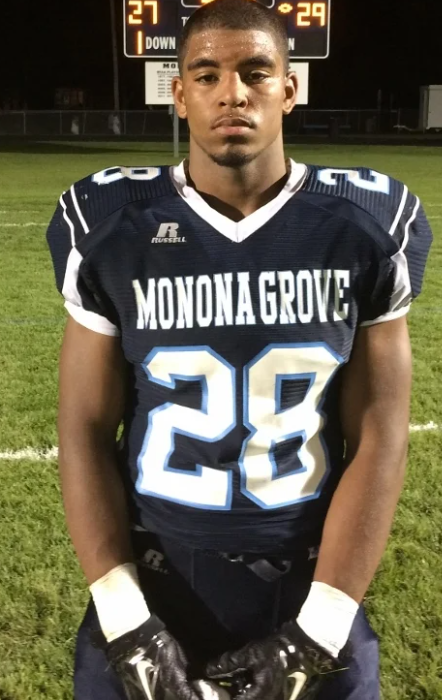
Young began playing football in fourth grade and, from the beginning, running back was his position. By the time he reached his senior year at Monona Grove, he had nearly nine years of experience learning how to play it.
His development was not simply physical.
“I’ve gotten a lot smarter,” Young said in 2015. “I get the schemes a lot better, the blocking schemes, when to make cuts, how to run certain routes.”
That detail becomes particularly interesting now.
As a player, Young learned to see more than the football. He learned schemes, blocking structures, timing and how one player’s movement could change opportunities elsewhere. As a head coach, that perspective has expanded from one position to an entire team.
It also connects naturally to the style of offense in which he became one of Monona Grove’s greatest players.
Young Played in a Different Version of Monona Grove Football
Young’s return to the MG story provides a natural connection between two very different offensive eras.
The Monona Grove offense Young played in during his final season looked considerably different from the one Silver Eagle fans have watched over much of the past decade. In 2015, sophomore Alec Ogden took over as the varsity starting quarterback, while Young was the veteran centerpiece behind him.
MG operated heavily from under center and leaned on a physical Power-I identity. The offense was constructed around downhill running, lead blockers, pulling linemen and the ability to repeatedly hand the football to one of the best runners in Wisconsin.
Opponents knew where the offense wanted to go. Stopping it was another matter.
Young could handle extraordinary volume. His 333 carries as a senior reflected both his durability and Monona Grove’s confidence that repeatedly giving him the football remained one of the best options available.
That version of the Silver Eagle offense matched Young perfectly: physical, patient, direct and difficult to stop even when the defense understood what was coming.
Yet even then, Young understood the strategic value created by simply being on the field. If defenses overcommitted to stopping him, he wanted Monona Grove to punish them somewhere else.
That is the same fundamental conflict offensive coaches still try to create today: force a defense to dedicate additional resources to one threat, then attack the space created elsewhere.
Then Young graduated.
Almost immediately, Monona Grove football entered another offensive era.
2016 and the Beginning of a New Offensive Identity
The 2016 season marked Tim Halverson’s first year as Monona Grove’s offensive coordinator. It also represented one of the more significant schematic transitions in the program’s modern history.
The Silver Eagles moved away from the traditional under-center Power-I identity that had defined much of Young’s career and transitioned toward the spread concepts that have remained foundational to the offense ever since.
The change did not require a long rebuilding period.
In the first season of the new system, Monona Grove advanced all the way to the state championship game. The Silver Eagles ultimately lost a 42-36 thriller to Brookfield East, but the 2016 run demonstrated that MG had successfully moved into a different offensive era without lowering its expectations.
Young’s graduation therefore marked more than the departure of an extraordinary running back. It came almost exactly at the dividing line between two generations of Monona Grove offense.
Young had been the ideal feature back for the old one.
Halverson helped build the framework for the next.
Ten years later, those eras are connected again. Halverson remains part of the Monona Grove staff. Beckwith remains at the center of the program. And Young is now attempting to establish his own offensive identity only a few hundred yards away at La Follette.
From Playing in a Program to Building One
Young’s challenge now is fundamentally different from anything he faced as a player. A running back can influence a game with 25 carries, but a head coach has to influence an entire program. That means developing players, organizing a staff, establishing standards, creating offseason expectations, managing special teams, building confidence and convincing teenagers that daily preparation matters long before anyone sees the results on Friday night.
In some ways, however, the leadership philosophy Young described as a Monona Grove senior fits naturally with what he is being asked to do today. Back then, he talked about knowing when to lead verbally and when to allow other captains to take ownership. He understood that leadership was more effective when it was shared rather than monopolized.
A head coach faces the same challenge on a much larger scale. He has to establish direction without trying to control every voice in the program. He has to develop assistant coaches, captains and younger players into leaders themselves.
Young took over La Follette during the summer of 2026, replacing Austin Wills, another coach with Monona Grove connections. That continuity makes the matchup even more unusual. La Follette and Monona Grove are neighboring schools geographically, but their football programs have also become increasingly connected through people, with Young now the most prominent example.
He learned what a successful high school football program looked like from the inside. He experienced a state championship, played on teams expected to compete for conference titles and saw firsthand how coaches handled preparation, accountability and postseason football. He also experienced what Beckwith emphasized throughout his playing career: improvement came from showing up repeatedly and doing the work.
Now Young has to decide which parts of those experiences belong at La Follette and which elements must become uniquely his own. Building that identity will take far longer than one season, but Thursday night offers one of the first visible markers of the process.
For the first time as a head coach, Young will stand across the field from the program that helped shape many of his ideas about football.
A Coaching Tree Only a Few Blocks Apart
There is an obvious temptation to call Thursday a homecoming, even if it is not one in the traditional sense. Young is not returning to John Klement Stadium or walking onto his former home field as the visitor. Instead, Monona Grove will travel to him.
But the geography makes that distinction almost amusing. Few road trips in high school football require covering less distance between school properties. The south edge of Monona Grove High School and the north edge of La Follette High School sit only about 500 yards apart as the crow flies, making two programs that already share people, history and football ideas almost literal neighbors.
On Thursday, those connections will become visible on opposite sidelines. Brandon Beckwith will lead Monona Grove, Toren Young will lead La Follette, and Tim Halverson will remain part of the MG staff representing the offensive generation that immediately followed Young’s playing career.
Many of the players on both teams were still in elementary school—or not yet in school—when Young was rushing for nearly 2,800 yards during his senior season. To them, Toren Young is a coach.
To longtime Monona Grove followers, he remains much more: the sophomore who rushed for 159 yards in a state championship game, the junior and senior captain, the workhorse running back, the All-State player, the All-American and the highly recruited senior who once told an interviewer that college football could wait because his attention remained on playing one more season with his Monona Grove teammates.
He was the player who once carried an offense.
Now he carries responsibility for an entire football program.
For One Night, Friends Become Opponents
There will be plenty of time Thursday night to discuss formations, turnovers, explosive plays and the scoreboard. Those things matter. Beckwith is trying to move Monona Grove to 2-0, while Young is trying to continue building credibility and momentum at La Follette. Neither coach will approach the game as an exhibition or reunion.
For three hours, Beckwith’s responsibility will be to defeat someone he helped develop, while Young’s responsibility will be to defeat the program that helped develop him.
That competitive reality may be exactly what makes the matchup meaningful. Their relationship does not require either man to want anything less than victory.
More than a decade ago, Young summed up his priorities in the simplest possible terms: “I just want to win football games.”
Thursday night, both he and Beckwith will want exactly that.
When the game ends, one will have won and one will have lost. Then the helmets will come off, the field will begin to empty and the short distance between Monona Grove and La Follette will feel small again.
Whatever the scoreboard says, Thursday will represent something larger than a Week 2 football game. One of Monona Grove’s most influential former players will have taken another step in his coaching career, and for the first time, Brandon Beckwith will have watched him do it from the opposite sideline.
Eleven years after Beckwith said he wished he could have Young for another four years, the two are still sharing a football field.
Just not the same sideline.



Comments